-A Race, Remembered and How It Unfolded
With the 2026 edition of the Promise Land 50k marking its 25th anniversary, it creates an opportunity to reflect on a small part of the event’s history.
The first year, in 2001, was a fun, low-key event with little fanfare or attention outside of the region’s geographic area, but by 2002, that had changed.
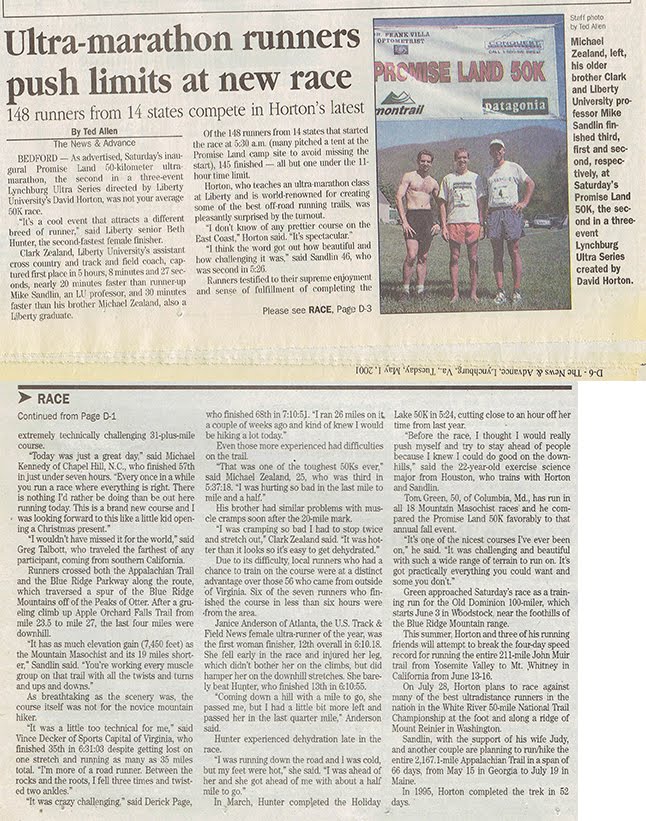
News & Advance Post-race Story, May 1, 2001
The 2002 starting line was a veritable who’s who in ultrarunning. Just to name a few:
Scott Jurek, who had already won his 3rd Western States 100, on his way to winning 7 in a row;
Hal Koerner, who had already won three of his 5 wins at The Bear 100 before going on to win Western States twice and Hardrock 100; William Emerson, coming off his 50-mile National Championship win in late July of 2001; Will Harlan, a fast newcomer testing his mettle in the sport; and Dink Taylor & Dewayne Satterfield, two of the most competitive mainstays in ultrarunning for more than a decade leading up to this race.
And then there was me. By April of this year, I had been a member of the Montrail–Patagonia Ultrarunning Team for nearly two and a half years and had been fortunate to finish more than a dozen ultra-distance races, with all but one resulting in a podium finish. Even so, I still treated each race day as something of a quasi-experiment, a way to explore different approaches to racing and testing my limits.
This was not going to be like the leisurely affair that led to my win at the inaugural edition of Promise Land the previous year. By its second year, the race had joined the newly formed Montrail Ultra Cup (MUC), an early 2000s U.S.-based series that, in some ways, foreshadowed the kind of coordinated, high-profile trail running circuit we now see globally with the UTMB World Series. The MUC was designed to bring together the best in the sport and highlight the competitive talent in North American ultrarunning, with Montrail shoes (purchased by Columbia Sportswear in 2006) among the first sponsors to offer prize money for elite runners. It played a significant role in raising the profile of both trail and ultrarunning in the early 2000s and often served as a qualifying pathway to major events like the Western States 100-Mile Endurance Run.
It was a new chapter in our sport and, just like with some of today’s rhetoric, a few critics at the time voiced displeasure with this growth of the sport, labeling MUC race directors as “selling out.” The thinking was that the natural maturation of the sport from its more bohemian roots somehow meant a rejection of its heritage, but nothing could have been further from the truth. To be sure, Promise Land (and its geographic cousin, the Mtn Masochist 50-mile or MMTR as it’s known) were early adopters of this direction and benefited from the talent and attention it attracted.
That said, some of us had also been touted as up-and-coming “young guns” in the sport by Trail Runner Magazine, and this was the backdrop that set the stage for what would become one of the most memorable 50k’s in the history of the event and arguably, the sport. What follows is how I remember that day unfolding.
Race morning came early, as it usually does.
The cool air that you briefly enjoy at the 5:30 a.m. start dissipates quickly as you begin climbing almost immediately, gaining 300 feet in the first mile. The climb doesn’t relent.
After the opening 4-mile climb of more than 2,000 feet, Hal apparently decided he was going to cover the next very runnable 6 miles as if he were running a 5K. Around that time, I had stopped to stretch my inflamed Achilles, the same one that would eventually undergo reconstructive surgery years later. Once I caught back up to most of the lead chase pack, I asked, “Who’s in the lead?”
Scott said, “Hal just took off at a crazy pace.”
For some reason, I decided right there that chasing him would be my experiment for the day, whether it made sense or not. So, I took off in search of the lone leader.
It took nearly twelve miles to get back within eyesight of him. When I finally did, I eased off a bit to recover from the intensity of the chase. Crossing the Blue Ridge Parkway, I looked behind and saw no one. I’m sure they were chasing, but clearly they had decided Hal’s early pace was not a wise approach.
For the next eight miles, I kept him in view, maintaining distance while he showed no signs of relenting. As we approached the Colon Hollow aid station, I found myself gradually gaining ground. At that moment, I sensed a brief hesitation in Hal’s body language, subtle in nature, but something that keen, experienced athletes both recognize and actively look for in their competitors. I quickly refilled my bottle and left the aid station, knowing this was the moment.
With Hal right behind me, I dropped the hammer.
The next 4.5 miles unfolded at a pace that made very little long-term sense, but long-term thinking was no longer part of the calculation.
I knew a short but incredibly important out-and-back section into and out of the Cornelius Creek aid station was coming up and, as any strategically competitive trail runner will tell you, “out of sight, out of mind.” While the entire out-and-back section is just over a quarter mile, those paying attention could see their competition on the parallel trail for nearly a mile. So I kept the pressure on and leaned into it.
I knew the pace was not sustainable, but sustainability wasn’t the decision criteria at that point. What mattered was ensuring that the surge I had just put forth created both physical and mental separation.
When I no longer saw anyone behind me, a feeling of relief rushed in, but it was immediately paired with something else, a feeling of running scared. I knew this entire elite field of trail runners was chasing me down, and I also knew I had the toughest, most infamous section of the Promise Land 50k course still ahead.
According to the Strava segment (https://www.strava.com/segments/7055275), the section of the Promise Land course that climbs up the Apple Orchard Falls trail is right around 3 miles and gains just under 2,200 feet of elevation. Overall, it averages a tough but manageable grade of 12.4%, but anyone who runs this trail, let alone hikes it, knows that doesn’t come close to telling the whole story. Those who climb this trail, particularly more than 25 miles into a race that is really closer to 33 or 34 miles, will attest that it’s the middle section, negotiating the technical terrain, passing the waterfalls, and climbing the dreaded 175 steps, that defines both the crux of the climb and the most grim and beautiful part of the entire course.
As the climb steepened, the fatigue in my legs became more pronounced, and the usual late-race questions began to surface:
Did I surge too early?
Was Hal just biding his time on me, like I had done on him earlier?
Was Scott hunting me down?
What about all the other talent in this field?
With a hand on each knee, driving downward with each step, I power-hiked through the steps and covered the rest of the climb in the all-too-familiar rhythm of walk, jog, walk, shuffle, and repeat.
When I reached the aid station at Sunset Fields, at the top of that climb, I looked behind me again. No one in sight, and no one working at the aid station had heard anything from the previous aid station either. I had no idea how far behind those hunting me were. In preparing for this race, I had a sense that Sunset Fields would serve as the unofficial finish line. Whoever gets to this point in the lead has a good chance of holding on for the win, unless they bonk.
I wasn’t bonking, yet, but I had pushed so hard on the climb that I knew I was teetering on a very thin edge.
Again, that all-too-familiar mix of relief and fear came over me at the same time as I moved quickly through the aid station.
One last push to the summit of Onion Mountain, and then four miles and 2,000 vertical feet to lose before the finish line.
I ran the initial, technical descent as fast as I could, negotiating the rocky terrain and trying to get around each corner or switchback as quickly as possible.
Resisting the urge to look behind me, I reached the final gravel road and was able to open up my stride and pound out a sub-6-minute mile, and it was enough.
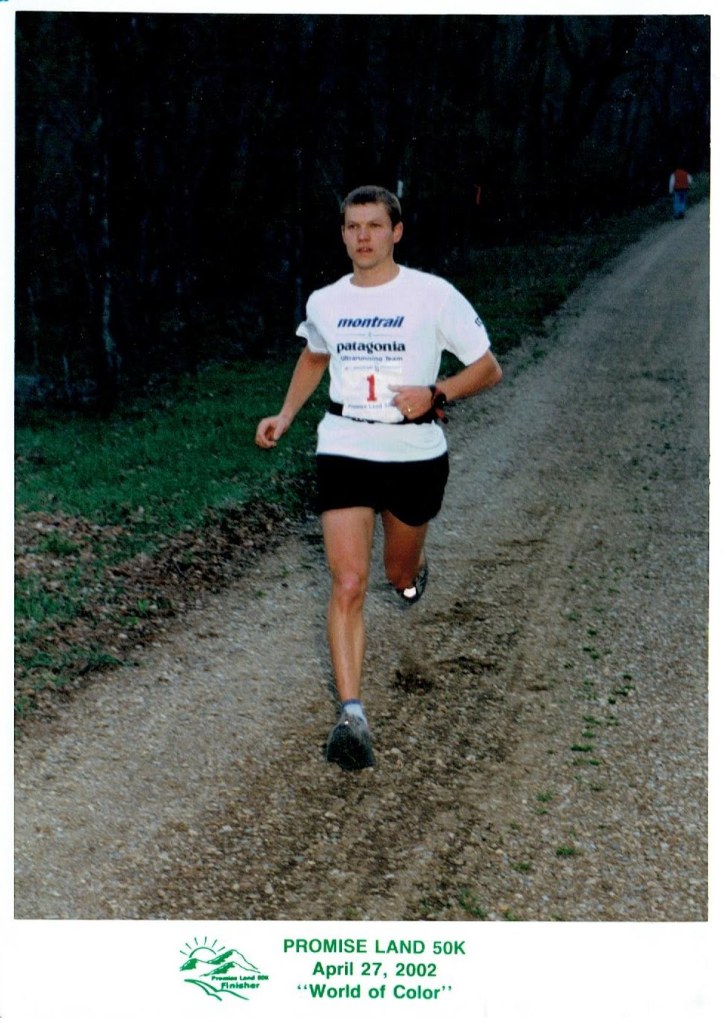
I crossed the finish line first in a time of 4:30, a course record that stood for a decade.
A few minutes later, Scott Jurek came storming in at 4:36, followed by Hal Koerner at 4:37, to round out the podium, and yes, they were both hunting me down.
That year, the top seven finishes were all under five hours. To date, the only other time that has happened at Promise Land was in 2012, when Eric Grossman broke the course record.
The women’s podium that year was just as formidable, with Krissy Moehl, Anne Riddle, and Laura Nelson, all national-class runners.
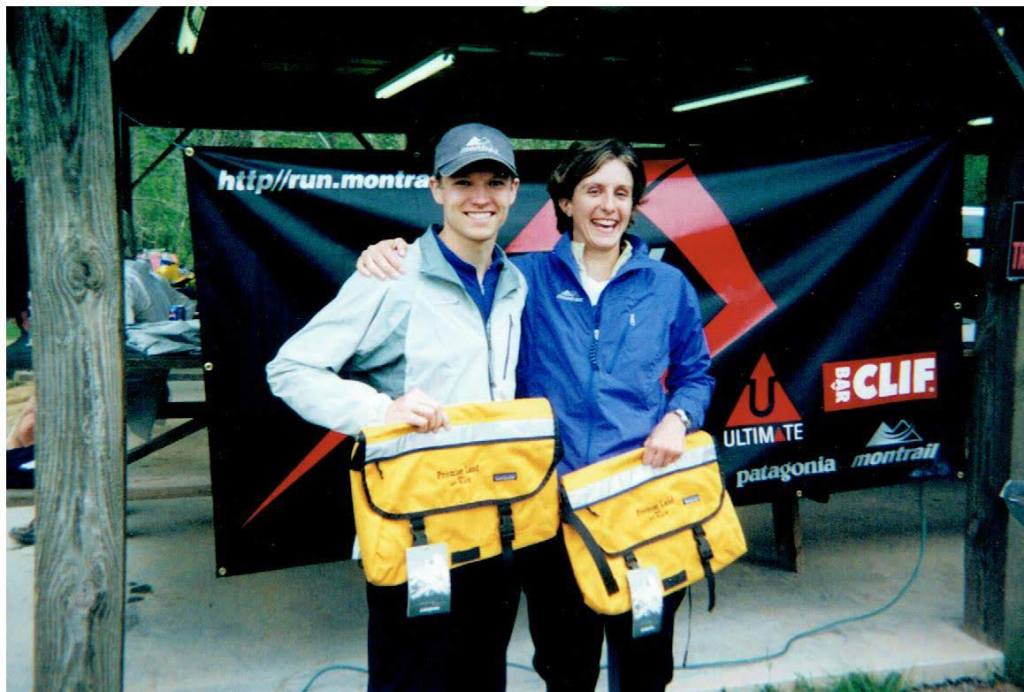
Krissy Moehl & me, Promise Land awards with MUC banner
At the time, it felt like a race that came down to a few key decisions. Looking back, it feels like something more than just that, not because of the result, but because of how it all unfolded and everything that has unfolded since.
Twenty-five years later, Promise Land is still here, and that probably matters more than anything that happened on a single day in 2001 or 2002.
For those lining up this year, the course will continue to demand what it always has. At some point, you’ll make a decision that feels right in the moment and questionable not long after, and you’ll find yourself managing effort, doubt, and whatever the day brings.
I hope you have a great experience out there.
This post is original content created by Compass & Cause, LLC. No part may be reproduced or shared without written permission. © 2026 Clark Zealand. All rights reserved.


Leave a Reply